The Therapist I Became While I Was Away: Motherhood, Career Gaps and Returning to Music Therapy
By Rebecca Human, MT-BC
What I Brought Back to Music Therapy
Picture a school morning. It’s 7:15 a.m. We need to leave at 7:30 a.m. One child just got out of bed. Nobody can find the hairbrush. Homework has disappeared despite my repeated reminders to put it in the backpack the night before. Someone now wants an elaborate breakfast requiring ingredients, mixing bowls, and significantly more than fifteen minutes.
Motherhood taught me to shift from what I wanted to have happen to what actually needed to happen to what this particular person needed from me right now.
Sometimes I could say, “I know you’re tired. This isn’t ideal, but we’re going to figure it out together.”
Sometimes I also had to say, “No, I can’t do that. What I can do is this.”
At the time, I wasn’t thinking about any of this as professional development. I was trying to get two children fed, dressed, and out the door.
Years later, back in the music therapy room after more than a decade away, I began to recognize something familiar.
Responding to someone’s needs doesn’t mean saying yes to everything. I can’t always provide exactly what a patient or family requests. I may not know a requested song or speak someone’s preferred language. Time, resources, setting, and my own abilities create real limitations.
But I can listen for the need underneath the request.
Then I can ask: What can I offer?
It was one of many moments when I began to understand that I hadn’t returned to music therapy empty-handed.
For years, I had worried about the opposite.
I thought I was returning to music therapy after more than a decade away. What I discovered was that those years had been preparing me to return as a different, and in many ways, stronger therapist.
When I first considered returning to the profession, I worried that I had become irrelevant. I had spent years raising my two daughters and working primarily in early childhood. Could I still work with adults? Was my repertoire hopelessly outdated? Was I still a good enough guitarist or vocalist? What had changed in research, technology, documentation, and clinical practice while I was gone?
Some of those fears were justified. A lot had changed. Returning meant learning new technology and documentation systems, updating repertoire, and refreshing clinical knowledge. I had also been away through the COVID-19 pandemic, which changed how many healthcare professionals worked and connected with patients.
What did I still have to offer?
I Thought I Had to Start Over
Before I found my way back into music therapy, I considered returning to school for a master’s degree in music therapy, thinking additional education might help me reenter the profession. But after applying for several music therapy positions without receiving an offer, I began to wonder whether returning was realistic at all.
I even looked into earning a teaching credential in music. Maybe teaching was simply a more practical path forward, one that would allow me to work in music while keeping a schedule similar to my children’s.
I began to wonder whether I needed to rebuild myself professionally from the ground up.
Then I finally stepped back into a music therapy role.
Within the first few weeks, small moments began changing the way I saw myself.
I sat with an anxious patient and listened. I recognized what the patient needed. We tried a relaxation experience, talked about what worked and what didn’t, and considered how the patient could use the experience outside our session.
I wrote clinical notes and realized, My brain still thinks this way.
Colleagues occasionally asked for my thoughts about music therapy, and my first internal response was almost comical: Why do you think I know anything?
Slowly, those moments accumulated.
Wait. I can do this.
More importantly, I began to recognize myself again. I hadn’t lost the ability to connect with another person or with the music.The knowledge and skills I needed to update were real, but so were the parts of me that had never gone anywhere.
The Résumé Didn’t Tell the Whole Story
From the outside, my years at home could look like a gap in professional development.
My actual days looked more like endless meal prep, diapers, library story time, parks, playdates, preschool, then elementary and middle school, art projects, doctor’s appointments, school activities, PTA meetings, fundraising, volunteer coordination, and not nearly enough sleep.
Along the way, I took on some per diem contract work, became a licensed Music Together provider, and ran a small business offering family music classes. I learned what it took to build and run a program, from marketing and budgeting to scheduling, teaching, and working with families.
Some of my most valuable learning, however, would never fit neatly into a job description.
Through PTA work, for example, I discovered that I loved connecting people. I could listen to someone talk about their interests and abilities, hear about a need somewhere else, and think, I know someone who could help with that.
I learned that people often want to contribute. Sometimes they simply need an entry point, a place where their abilities are recognized and welcomed.
Years later, I find myself doing the same thing professionally. I build relationships with nurses, social workers, physicians, chaplains, therapists, administrators, caregivers, and community organizations. I listen for needs and look for connections. Those relationships can lead to better collaboration, new programs, and new ways of serving people.
I didn’t know I was developing leadership skills.
I thought I was just in the gap.
The Plan Matters. The Person Matters More.
Motherhood also gave me years of practice being with another human being when things were not going according to plan.
Parenting taught me to recognize another person’s feelings without making them my own. I learned to notice when I was becoming overwhelmed and how my own state affected the people around me. I learned to wait, listen, observe, change course, and sometimes simply stay present.
Those lessons followed me directly into the therapy room.
Early in my career, I struggled to deviate from a session plan. If something didn’t work, I didn’t always know what to do next. As a mother, I received daily, and sometimes hourly, practice with Plan B, C, and D.
Sometimes music itself became my pivot. Rather than yell during a chaotic morning, I might sing in my fullest operatic voice, “Go put your shoes on!” A tense moment could suddenly become a ridiculous family musical.
Motherhood became an unexpected training ground for flexibility.
Now, when a music therapy session moves somewhere I didn’t anticipate, I am much more comfortable following what is happening in the room. I can ask myself: What does this person need from me right now?
The intervention I planned still matters.
The person in front of me matters more.
Flexibility was only one of the things I brought back with me. The longer I worked, the more I began to see that experiences I had once viewed as time away from professional growth had been shaping me all along.
Nothing Is Wasted
I’ve started to question the phrase employment gap.
A gap sounds empty.
Those years weren’t empty.
In a forest, a fallen tree doesn’t become useless when it stops standing. As it decomposes, it can become what ecologists call a nurse log, a place where moisture and nutrients collect and new life can take root.
I find myself thinking about my years away from music therapy in much the same way.
The shape of my life had changed. The professional growth that could be easily counted, clinical hours, job titles, continuing education, credentials, had slowed. But growth itself hadn’t stopped.
I was developing patience, adaptability, leadership, and the ability to sit with another person’s difficult feelings. I was learning my own limits, how to ask for help, and how to be present.
I hadn’t stopped developing simply because my résumé had.
Those years became part of the ground from which something else could grow.
I Still Had Catching Up to Do
None of that means reentry was easy.
I was rusty.
I needed a new repertoire. I needed to learn technology, electronic documentation, medical terminology, and changes within different clinical populations. I had to adjust to workplace culture and rediscover what it felt like to be a beginner.
Becoming a learner again in my forties has been humbling.
However, I’ve learned an important distinction between having a knowledge gap and losing confidence in what I already know and have to offer.
Knowledge can be acquired. I can ask questions. I can practice. I can learn from colleagues. I can read current research, listen to podcasts while I drive, and continue updating my skills.
Learning to trust what I already knew, and recognize what I had gained along the way, was harder.
Human development doesn’t stop when paid employment stops. Life doesn’t divide itself as cleanly as a résumé does.
There Is Gold in the Gap
I am not the therapist I was in my twenties.
I’ve lived through hard things. I’ve learned to sit with myself, and because of that, I can sit differently with someone else. I’ve learned that leadership doesn’t always look like being the person in charge. Sometimes it looks like recognizing what someone else has to offer and creating a place for them to offer it.
Motherhood taught me that I will continue to grow in ways I cannot yet fathom.
Staying home taught me that even the mundane can be sacred.
My children have become some of my greatest teachers.
Returning to work taught me what I’m made of.
Yes, I lost professional experience, credentials, titles, and earning power during my years away. I had skills to rebuild and knowledge to update. I don’t need to minimize those losses to recognize what I gained.
I was also home with my babies.
I was growing alongside them.
Nothing was wasted.
Maybe that’s what I’ve come to understand about the word gap. A gap doesn’t have to be an empty space between the places where the “real” story happened. A whole journey can live inside it.
My reason for stepping away was motherhood. Others leave the profession for caregiving, health, burnout, education, or simply because life takes them somewhere else. If you are considering stepping away from music therapy, or wondering whether you can return after time away, I hope my story offers some reassurance. Your path may look different from mine, and returning may require learning, practice, and courage. But time spent outside the profession does not mean that you have stopped growing. Pay attention not only to what you may need to relearn, but also to what you have learned along the way.
I thought I would return to music therapy empty-handed and have to start over.
Instead, I brought the journey with me.
There was gold in the gap all along.
Years ago, I sometimes wondered whether all my training as a music therapist would matter if I planned to stay home with my children. Looking back now, I can see that the relationship between those two parts of my life has always moved in both directions. They were never as separate as I imagined. They are parts of one life and one whole person.
But that’s a story for another day.
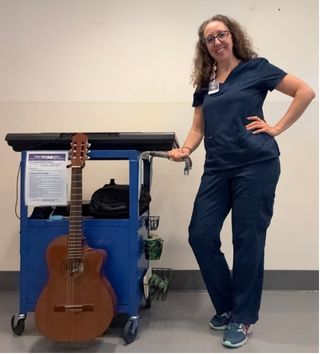
About the author: Rebecca Human, MT-BC, is a board-certified music therapist with MusicWorx in San Diego. She currently provides music therapy in medical and hospice settings.
Source for nurse-log description: U.S. National Park Service, “Old Mine Tour: Nurse Logs”